Colombia's Palace of Justice Siege: A Bloody Legacy Unpacked
The echoes of November 6, 1985, still reverberate through Colombia, marking one of the most tragic and contentious chapters in its modern history: the Palace of Justice siege. For nearly 28 harrowing hours, the nation watched in horror as the symbolic seat of its judicial power transformed into a battleground. This wasn't merely a standoff; it was a devastating confrontation that pitted a leftist guerrilla group, M-19, against the full might of the Colombian state, leaving behind a trail of death, destruction, and a profound legacy of unanswered questions about state responsibility, human rights, and the very nature of justice.
The Fateful Day: November 6, 1985
On that fateful Wednesday morning, approximately 35 members of the M-19 (19th of April Movement) guerrilla group stormed Bogotá's Palace of Justice, the majestic headquarters of the Supreme Court. Their objective was audacious: to seize control of the building and take over 300 hostages, including the nation's Supreme Court justices. The stated intent behind this shocking Palace of Justice Siege: M-19, Hostages & Colombia's War was to conduct a public trial against President Belisario Betancur's administration. M-19 accused the government of betraying peace negotiations and maintaining an extradition policy that many believed violated national sovereignty and intensified the ongoing internal conflict by targeting alleged drug kingpins for trial in the United States.
The takeover was swift, brutal, and meticulously planned, though its ultimate outcome would prove catastrophic. For M-19, a group known for its high-profile urban actions and theatrical flair, this was the ultimate challenge to state legitimacy, designed to force a political dialogue on their terms. However, the government's response would be equally decisive, setting the stage for an unprecedented tragedy.
Colombia's Deep-Rooted Conflict: A Nation on Edge
To fully grasp the magnitude of the 1985 Palace of Justice siege, one must understand the tumultuous political landscape of 1980s Colombia. The nation was mired in a decades-long internal armed conflict, characterized by a complex interplay of leftist guerrillas, state counterinsurgency efforts, and the insidious rise of narcotrafficking. Groups like the Revolutionary Armed Forces of Colombia (FARC), the National Liberation Army (ELN), and the Popular Liberation Army (EPL) controlled vast rural enclaves and urban networks.
M-19, distinct in its urban focus and nationalist rhetoric, sought to challenge the traditional oligarchic rule and what it perceived as U.S.-influenced capitalism. These groups funded their campaigns through ambushes, bombings, kidnappings for ransom, and extortion, increasingly intertwining with the emerging drug trade. FARC, for instance, by 1982, commanded around 3,000 fighters, focusing on rural taxation and territorial expansion. ELN specialized in sabotaging vital infrastructure, while M-19 opted for high-visibility actions to discredit the state.
President Betancur's administration (1982–1986) attempted a delicate balance of military offensives and peace overtures. In 1984, his government secured a ceasefire with FARC, which allowed the group's political arm, the Patriotic Union (UP), to participate in elections. The UP even won congressional seats in 1986, offering a glimmer of hope for political inclusion. However, this fragile truce quickly unraveled amid mutual accusations of violations. The subsequent systematic extermination campaign against UP members, with over 3,000 assassinations between 1984 and 2002—many attributed to security forces, paramilitaries, and drug cartels—served as a chilling deterrent to future demobilization efforts and underscored the deep-seated mistrust that plagued the peace process. This volatile backdrop provides crucial context for the desperation and extreme measures taken by groups like M-19, leading to events like the devastating Palace of Justice siege.
The Military Response and a City in Flames
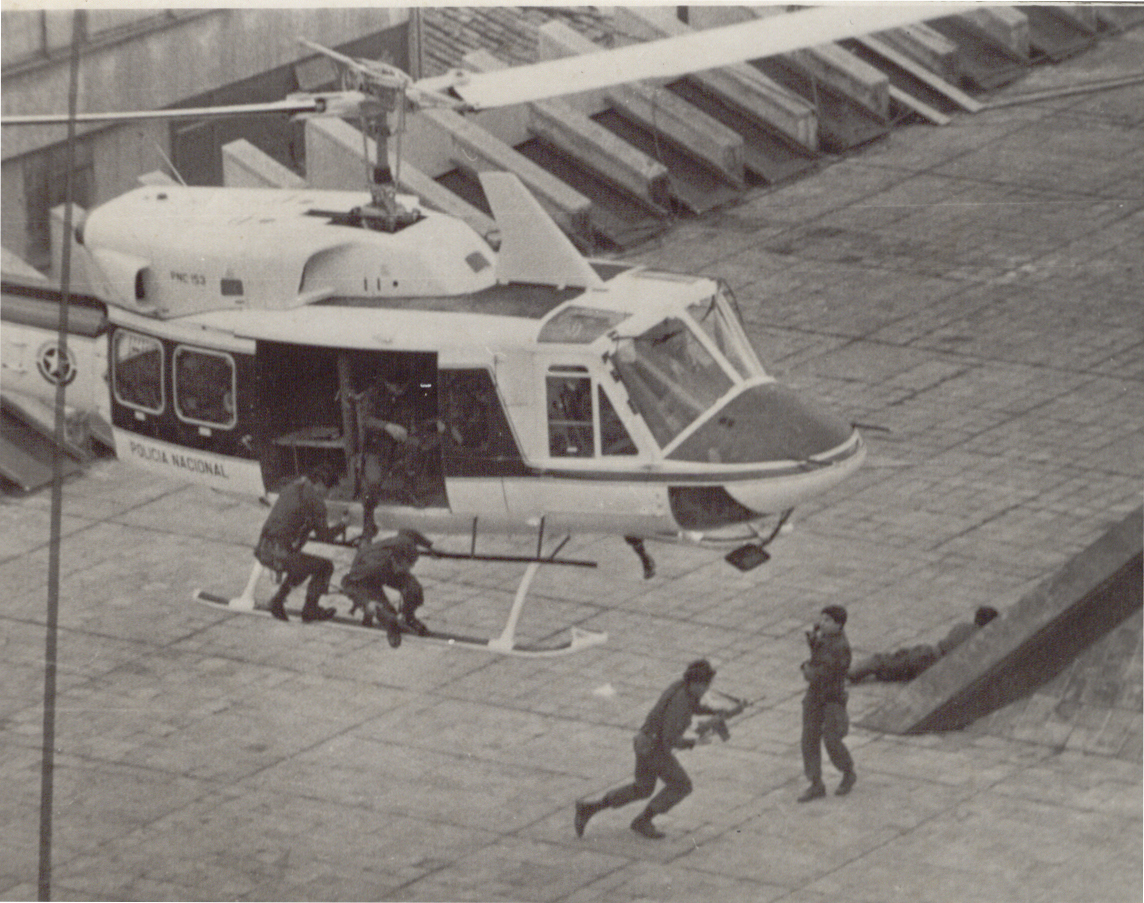
The state's reaction to the Palace of Justice siege was immediate and overwhelming. Elite units from the 13th Brigade of the Colombian military swiftly deployed, launching a counteroffensive to retake the building. What followed was nearly 28 hours of intense, brutal combat that turned the Palace of Justice into an inferno. The building, a symbol of national justice, was largely destroyed by relentless gunfire and fires, reportedly set by both sides during the fierce struggle.
The scale of the tragedy was immense. Over 100 people perished, including 11 of the 25 Supreme Court justices present, nearly all of the M-19 combatants involved in the assault, numerous military personnel, and innocent civilians caught in the crossfire. The images of the burning building and the desperate attempts to rescue survivors became ingrained in the national consciousness.
However, the immediate aftermath of the military's operation sparked enduring and painful debates. Allegations of extrajudicial executions, forced disappearances, and state cover-ups began to surface almost immediately. Critics questioned the proportionality of the military response, arguing that the government prioritized recapturing the building and eliminating the guerrillas over the lives of the hostages. This profound ethical dilemma is a central theme in discussions about the Palace of Justice Siege: Debating Colombia's Military Response, raising difficult questions about the responsibilities of a state in protecting its citizens during a terrorist attack.
A Legacy of Lingering Shadows: Justice, Truth, and Memory
The Palace of Justice siege left an indelible scar on Colombia's psyche, sparking decades of legal battles, political investigations, and a relentless search for truth. The accusations of extrajudicial killings and forced disappearances, particularly concerning some of the hostages and M-19 members who were reportedly seen leaving the building alive, led to prolonged judicial processes. Over the years, several high-ranking military officials faced charges and convictions, most notably General Jesús Armando Arias Cabrales, who was found guilty of forced disappearance in connection with the events. These legal outcomes underscore the persistent demand for accountability, even if decades after the fact.
The M-19 group itself eventually demobilized in 1990, signing a peace agreement with the government and transitioning into a legitimate political party. However, the shadows of the Palace of Justice siege continued to loom large, serving as a stark reminder of the devastating consequences when political grievances escalate into armed confrontation and when state responses cross ethical lines.
The event profoundly impacted Colombia's democratic institutions. The Supreme Court was decimated, its authority temporarily undermined, and the trust between citizens and state severely tested. The Palace of Justice siege also complicated future peace negotiations, highlighting the immense challenges of reconciliation in a deeply divided society. The pursuit of truth, justice, and reparations for the victims and their families remains an ongoing process, crucial for healing and for preventing such atrocities from recurring.
Beyond the Ashes: Learning from Colombia's Palace of Justice Siege
The Palace of Justice siege stands as a harrowing historical lesson, offering profound insights into the complexities of internal conflict, state power, and the pursuit of justice. It serves as a potent reminder of the fragility of democratic institutions and the catastrophic human cost when political discourse descends into armed violence. One crucial takeaway is the imperative for governments to adhere strictly to human rights principles and international humanitarian law, even under the most extreme pressure. The debates surrounding the proportionality of force and allegations of state misconduct highlight the critical importance of transparent investigations and robust accountability mechanisms.
For societies grappling with similar challenges, the Colombian experience underscores the long-term consequences of failing to address root causes of conflict and the immense difficulty of achieving lasting peace without comprehensive truth and reconciliation processes. It is a testament to the resilience of a nation that continues to grapple with its past while striving for a more peaceful future. The Palace of Justice siege cemented its place as a pivotal, tragic moment, forever woven into the fabric of Colombia's memory and its ongoing journey toward reconciliation and a stronger democracy.